
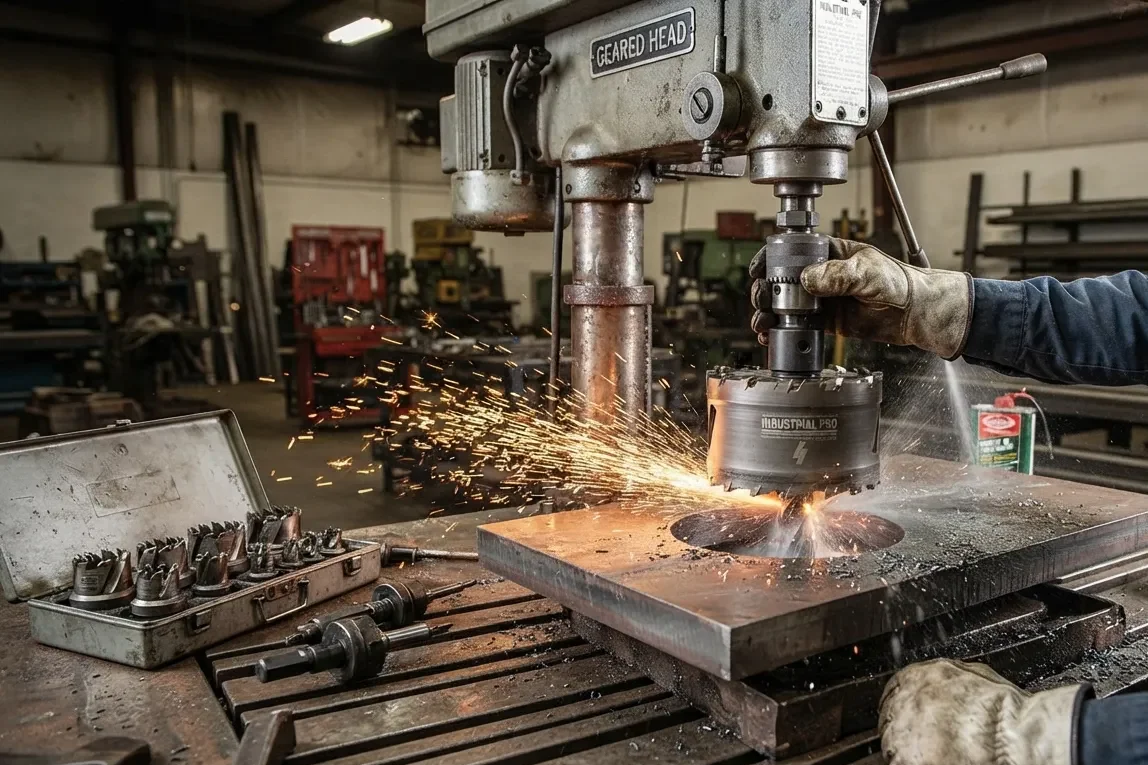
Source annular cutters from Newlands Fasteners & Engineering Supplies in Melbourne, reducing drilling time and improving structural steel workshop output.
Annular cutters remove a ring of material and leave a solid slug, making them a practical alternative to twist drills for larger holes in structural steel. We supply Melbourne workshops with drilling and engineering products matched to the job, machine and required hole dimensions.
How Do Annular Cutters Improve Structural Steel Drilling?
Unlike a twist drill, an annular cutter cuts around the hole’s circumference instead of removing the full core as swarf. This concentrates cutting at the perimeter. For suitable magnetic-drill or machine setups, the result can be faster penetration, lower cutting resistance and a cleaner hole that may need less finishing.
That distinction matters in workshops producing repeated holes through beams, channels and plate. The cutter still needs to suit the material, hole diameter, cutting depth, arbour and machine. Annular cutters are not an automatic replacement for every twist drill; twist drills remain appropriate for small diameters, pilot holes and equipment that cannot accept annular tooling.
What Should Workshops Check Before Ordering Annular Cutters?
Start with the drawing and the equipment, not a vague request for ‘a cutter’. Confirm the finished diameter and material thickness, then check the machine’s arbour, available stroke, speed range and coolant arrangement. Our drills and engineering supplies range includes annular cutters, and we can help narrow the specification before you order.
Key purchasing details include:
- Hole diameter: Match the cutter to the drawing and connection requirement rather than relying on a worn sample.
- Cutting depth: Choose a cutter with enough reach for the section or plate without assuming all cutters share the same depth.
- Machine compatibility: Verify arbor type, drive system, pilot pin and the magnetic drill or machine manufacturer’s instructions.
- Material and condition: Identify the steel grade, coatings, scale and any interrupted cut that could change tool selection or operating conditions.
- Consumables: Plan for compatible pilot pins and cutting lubricant so replacement tooling is ready when production starts.
How Can Annular Cutters Reduce Rework and Downtime?
Correctly selected tooling supports repeatable holes and reduces time lost to step drilling, excessive swarf and avoidable finishing. It also makes replenishment easier: a workshop can record the cutter diameter, depth, shank or arbour and associated pilot pin, then reorder against a clear specification.
Tool choice does not replace fabrication control. Hole locations, tolerances and workmanship still need to follow the project documentation and applicable requirements. The Australian Steel Institute’s free AS/NZS 5131 implementation guide explains how the fabrication standard supports project specifications and conformity assessment; a cutter alone is not proof of compliance.
For related circular-cutting considerations, our article on hole saw supply for metal fabrication workshops explains another tooling category. The two products are not interchangeable in every application, so machine fit and job requirements should drive the decision.
Order Annular Cutters for Your Melbourne Workshop
We stock annular cutters within our broader drill range and can source unusual engineering supplies where required. Send us the hole diameter, cutting depth, material and machine or arbour details, and we will help identify a suitable option without padding the order with irrelevant products.
Contact us for an annular cutter quote or availability check for your next structural steel job. A clear specification is enough to start the enquiry.